- Table of contents
- What is the Lunchtime Sound Bath?
- Why do it at lunchtime instead of the evening?
- What actually happens in the 60 minutes?
- The science: why sound calms the nervous system
- Who is a lunchtime sound bath for?
- What to expect as a first-timer (and how to prepare)
- Meet your host: Kasia Richter
- The space: inside Wellbeing House
- Five myths about sound baths, cleared up
- Pricing, packages and how to book
- How to find Wellbeing House
- FAQ
- Final word
1. What is the Lunchtime Sound Bath?
Quick answer: It is a 60-minute midday sound therapy session in West Wimbledon where you lie down comfortably and are immersed in the sound of symphonic gongs, Tibetan bowls and chimes. The aim is simple: calm your nervous system, help you switch off from the morning, and send you back into your afternoon lighter and clearer.
A sound bath is not a bath with water. The word “bath” describes the feeling of being surrounded, or bathed, in sound waves from every direction. You stay fully clothed, lie under a blanket, and do nothing. There is no chanting to learn, no posture to hold, and nothing you can get wrong.
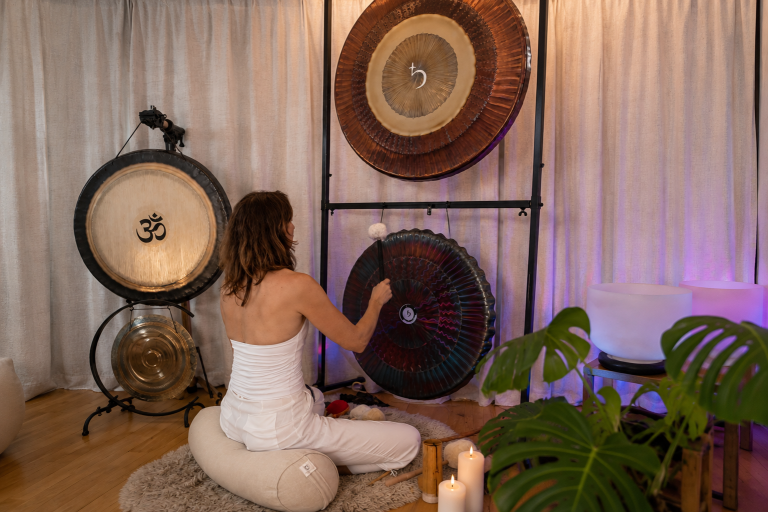
What makes this particular session distinctive is the timing and the instruments. It runs at 1:30 PM, which places it squarely in the middle of a normal working day rather than at the end of it. And it is built around two large symphonic Paiste gongs and a 95cm planetary gong from Universe Gongs in Portugal, instruments that are rarely found in London’s boutique wellness spaces. The scale of those gongs is part of why the experience feels physical, not just audible.
The session is capped at eight guests and often has fewer. That cap is deliberate. It keeps the room quiet, personal and unhurried, closer to a private session than a crowded class.
Remember: “Sound bath” is a metaphor. You stay dry, dressed and horizontal. The only thing washing over you is sound.
2. Why do it at lunchtime instead of the evening?
Quick answer: A midday reset interrupts stress while it is still building, instead of waiting until the day has already worn you down. You return to your afternoon with a regulated nervous system, better focus and more patience, rather than pushing through on adrenaline and caffeine until 6 PM.
Most wellbeing routines are scheduled for after work, when you are already depleted. By then the cortisol has been climbing for hours, decisions feel heavier, and your attention is fragmented. A lunchtime session works on a different principle. It treats the middle of the day as a checkpoint, not an afterthought.
There are three practical reasons the midday slot works so well:
- It resets your focus for the hours that pay. Your afternoon is often when the hard thinking, difficult conversations and creative work still need to happen. Coming back to that with a settled nervous system changes the quality of what you produce.
- It protects your evening. When you decompress at lunch, you are less likely to arrive home frazzled and spill the day’s stress onto the people you live with. The reset happens before the overflow.
- It is sustainable. A 60-minute midday pause fits into a real diary far more easily than a two-hour evening commitment after a long day. Sustainable beats intense.
This is the same reasoning behind Kasia’s writing on why stepping away actually improves performance. If you want the longer argument, her article on the power of taking a break makes the case in full.
Worth knowing: Many guests describe leaving a lunchtime session “deeply rested yet somehow refreshed.” That combination, rest without grogginess, is exactly what a well-timed midday reset is designed to produce.
3. What actually happens in the 60 minutes?
Quick answer: You arrive, settle in with herbal tea, then lie down covered and comfortable. Kasia may begin with gentle breathwork or a short meditation to help you land. Then the soundscape builds live, gongs, bowls and chimes, and carries you into deep stillness. You are gently brought back at the end, with time to sit before you leave.
Nothing is asked of you during the session. That is the point. Here is the usual arc:
- Arrival and grounding. You are welcomed into the lounge, offered herbal tea, and given a moment to slow down before anything begins. Upstairs, the studio is already set with mats, blankets, eye masks and pillows, so all you do is get comfortable.
- Settling the nervous system. Sessions may open with guided breathwork, a short meditation, or gentle movement. This is the bridge between “still in work mode” and “actually here.”
- The sound journey. The soundscape is created live, not from a recording. The instruments are chosen for their ability to shift brainwave activity, moving you out of the busy, thinking beta state and into the calmer alpha and theta states where the body genuinely restores.
- Reflection. An oracle or therapeutic card pull is often offered for gentle reflection and intention-setting. It is an invitation, never an obligation.
- The return. You are eased out of the deep state slowly, with time to notice how you feel before you re-enter the day.
You do not need to “meditate correctly.” If your mind wanders, that is fine. If you drift close to sleep, that is fine too. The sound does the regulating whether or not you are trying.

4. The science: why sound calms the nervous system
Quick answer: Sustained, resonant sound helps shift the brain from an active, alert state into slower brainwave states linked to deep rest. Research on sound and singing-bowl meditation has been associated with lower stress and anxiety, pain relief, improved mood and better mental clarity.
Sound healing is an ancient practice, but it has drawn genuine scientific interest for measurable effects on the body and mind. Here is what the research points to, with the sources Kasia references directly.
Stress and anxiety reduction
Sound-based meditation, including Tibetan singing bowl sessions, has been linked to significant reductions in tension and anxiety, with participants reporting improved mood afterward. See the study on PubMed Central (PMC).
Pain relief and physical wellbeing
The vibrations from instruments like singing bowls have been associated with reduced muscle stiffness, improved circulation and lower blood pressure, and have shown promise for different kinds of physical discomfort. More via Psychology Today.
Emotional and spiritual wellbeing
Participants in sound meditation have reported meaningful reductions in negative emotions alongside an increased sense of connectedness, as discussed in this peer-reviewed research.
Mental clarity and focus
By lowering stress and fatigue, sound practices have been associated with sharper focus and improved cognitive function, as covered by National Geographic.
The mechanism most often described is entrainment. Your brainwaves tend to fall into step with a steady external rhythm. When the gongs and bowls sustain slow, rich tones, the nervous system has something calm to synchronise with, and it follows. That is why the effect feels less like being entertained and more like being downregulated.
Note: A sound bath is a wellbeing and relaxation practice, not a medical treatment. It complements, rather than replaces, professional care for any diagnosed physical or mental health condition. If you are pregnant, have epilepsy, or have specific health concerns, mention them when you book so the session can be adjusted.
For a fuller explanation of the mechanisms, Kasia’s article on the benefits of sound therapy for mental health and wellbeing goes deeper. You can see also podcast about Sound bath is the new Happy Hour on YouTube.
5. Who is a lunchtime sound bath for?
Quick answer: It suits busy professionals, founders and decision-makers who run hot all week, as well as complete beginners who have never tried anything like it. No flexibility, experience or spiritual belief is required. If you can lie down, you can do this.
It tends to resonate most with a few groups:
- Entrepreneurs and business owners carrying constant low-grade pressure, who need a reliable way to discharge it before it becomes burnout.
- Corporate professionals and leaders whose calendars are relentless and whose afternoons demand clear judgment. Kasia writes specifically for this group in her piece on managing stress as a CEO.
- People new to meditation who find seated silence difficult. A sound bath gives your mind something to follow, which makes “switching off” far easier than trying to force stillness.
- Anyone in the Wimbledon, Raynes Park or wider South West London area who wants a genuine reset without a long journey or a big time commitment.
The testimonials reflect that range. A CEO described leaving her first session completely stress-free and planning to rebook. A physiotherapist said it left him feeling like a new person. An office manager called it a rare talent for soothing people. Different lives, same result.
6. What to expect as a first-timer (and how to prepare)
Quick answer: Wear comfortable clothes, arrive a few minutes early, and expect to do nothing but lie down. Everything you need, mats, blankets, eye masks and pillows, is provided. Come as you are.
Use this short checklist so you arrive relaxed rather than rushed:
- Wear layers you can relax in. Body temperature drops when you lie still, so something warm helps.
- Arrive 5 to 10 minutes early. This gives you time for tea and to settle, rather than dashing in mid-breath.
- Eat lightly beforehand. A heavy lunch right before lying down can be uncomfortable. Something small is ideal.
- Turn your phone fully off, not just silent. The absence of the possibility of interruption is part of the medicine.
- Let go of “doing it right.” There is no correct experience. Some people float, some fall asleep, some cry, some simply rest. All of it is valid.
- Flag anything relevant when booking. Pregnancy, epilepsy, recent injury or specific concerns are all worth mentioning in advance.
Remember: You cannot fail a sound bath. If you spend the whole hour thinking your to-do list, your nervous system is still receiving the sound. The benefit is not conditional on a quiet mind.
7. Meet your host: Kasia Richter
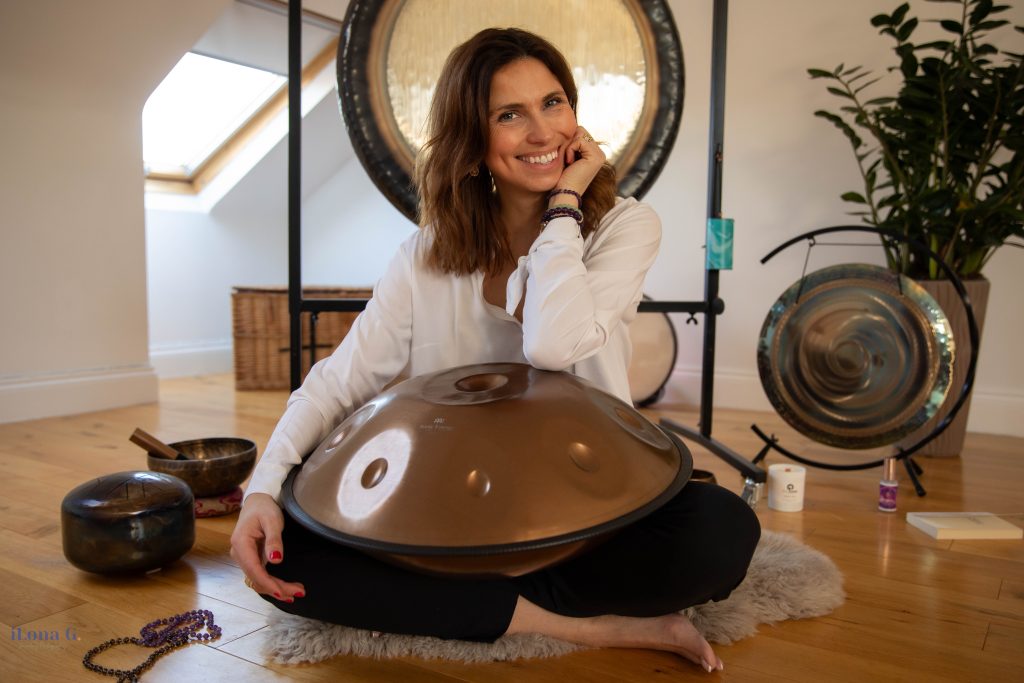
Quick answer: Kasia Richter is a holistic psychologist, yoga teacher and certified sound therapy practitioner, and the founder of Wellbeing Strategist. She designs science-based wellbeing strategies for driven entrepreneurs and professionals, and brings years of international corporate experience to how she holds a room.
What sets these sessions apart is the combination behind them. Kasia leads with dual expertise in psychology and vibrational therapy, which means the hour is shaped by an understanding of both the nervous system and the person lying on the mat.
Her background is unusual for the wellness world. Before Wellbeing Strategist, she held managerial roles in aviation, responsible for recruitment and people development. That corporate experience is exactly why her work lands with professionals: she has lived the pressure she now helps people release. Her methods draw on psychology, yoga, sound healing and Theta Healing, always grounded in evidence rather than mysticism.
Her sound work has also been recognised beyond the wellness circuit, including an award from the hi-fi and audio world, a nod to the quality and intentionality of the soundscapes she creates. You can read more about her approach and story on her about page.
Worth knowing: Because Kasia is a psychologist as well as a sound therapist, these sessions are held with real care for what surfaces. Sound can loosen things that have been held tightly for a long time, and she is trained to hold that safely.
8. The space: inside Wellbeing House
Quick answer: Wellbeing House is an intimate, residential sound studio in quiet West Wimbledon. A welcoming lounge invites you to slow down over herbal tea, and a dedicated upstairs studio is set with everything you need. It is deliberately not a spa and not a gym.
The setting matters more than people expect. A reset does not happen in a rushed, clinical room. Wellbeing House is designed to feel like stepping out of the city and into somewhere that has already exhaled for you.
- The lounge. You arrive here first, slow down, and are offered herbal tea before anything begins.
- The studio. Upstairs, the dedicated space is laid out with mats, blankets, eye masks and pillows, so all you do is settle in.
- The instruments. Two large symphonic Paiste gongs and a 95cm planetary gong anchor the room, a setup rarely found in London’s boutique wellness venues.
- The scale. Sessions stay small, never more than eight, which keeps the room calm, personal and entirely yours.
- Dog-friendly. The house welcomes dogs. If you want to bring yours, book a private session so everyone stays comfortable.

You can see the full studio and current schedule on the Wellbeing House page.
9. Five myths about sound baths, cleared up
Quick answer: Sound baths are not religious, not difficult, not only for “spiritual” people, not a nap, and not something you can do wrong. They are a simple, evidence-informed way to downregulate a stressed nervous system.
Myth 1: “It is a religious or spiritual ceremony.” It is not. Sound therapy is used purely as a nervous system practice here. You do not need to believe anything for the physiology to work.
Myth 2: “I am too busy and analytical for this.” Analytical, high-pressure people are often the ones who benefit most, precisely because their systems rarely switch off. The sound gives a busy mind something to follow instead of fighting silence.
Myth 3: “It is basically just a nap.” Some people do drift toward sleep, but the state a sound bath induces is different from ordinary sleep. It is a rested, aware stillness, which is why you can feel both deeply relaxed and refreshed afterward.
Myth 4: “I need to be flexible or good at meditation.” You lie down. That is the entire physical requirement. No experience, flexibility or technique is needed.
Myth 5: “One session will not do anything.” Many people feel a clear shift after a single session. Regular practice deepens the effect over time, which is why multi-session journeys exist, but a first session stands on its own.
10. Pricing, packages and how to book
Quick answer: A single New Chapter Lunchtime Sound Bath is £38. If you want to make it a habit, a 5-session journey is £125 and an 8-session journey is £180. Places are capped at eight and fill quickly, so booking ahead is wise.
| Option | Price | Best for |
|---|---|---|
| Single session | £38 | First-timers and occasional resets |
| 5-session journey | £125 | Building a monthly rhythm (saves vs single) |
| 8-session journey | £180 | Making sound a consistent practice (best value) |
- Single session £38: Reserve on Calendly
- 5-session journey £125: Book the journey
- 8-session journey £180: Book the practice
Because the room holds a maximum of eight and often fewer, spaces genuinely do sell out. If the Thursday you want is full, the sessions run weekly, so the next one is only days away.
Note: The sessions are every Thursdays at 1:30 PM. The lunchtime and reset sound baths run on a weekly Thursday rhythm, so you can pick the date that fits your diary when you book.
11. How to find Wellbeing House
Quick answer: Wellbeing House is at 58 Durham Rd, SW20 0TW, in West Wimbledon near Raynes Park. It is an 8-minute walk from Raynes Park station, with parking available in front for those driving.
- By train: From Raynes Park Station, walk 5 minutes to 58 Durham Rd. Look for a narrow passage between buildings, then head to the black gate, which is the entrance to Wellbeing House.
- By car: Drive to 58 Durham Rd, SW20 0TW. There is a car park in front of the building. Look for the same narrow passage between buildings and enter through the black gate to reach the studio.
The location sits in a quiet residential pocket, which is part of why the space feels so calm the moment you arrive.
FAQ
1. What is a lunchtime sound bath? A lunchtime sound bath is a midday relaxation session where you lie down and are immersed in sound from gongs, bowls and chimes. Instead of recovering after work, you reset in the middle of the day, so you return to your afternoon calmer and more focused. This one runs for 60 minutes in West Wimbledon and is designed specifically as a working-day nervous system reset.
2. How long is the session and what time does it start? The New Chapter Lunchtime Sound Bath is 60 minutes and starts at 1:30 PM every Thursday. Arriving 5 to 10 minutes early is recommended so you have time to settle with herbal tea before the session begins.
3. Do I need any experience with meditation or yoga? No. Sound baths require no experience, flexibility or technique. You simply lie down, and the sound does the work. In many ways they are easier than seated meditation, because your mind has the soundscape to follow rather than having to force silence.
4. What should I wear and bring? Wear comfortable, warm layers, since your body temperature drops when you lie still. Everything else, mats, blankets, eye masks and pillows, is provided. Bring only yourself, and switch your phone fully off.
5. How much does it cost? A single session is £38. There is also a 5-session journey for £125 and an 8-session journey for £180 for those who want to build a regular practice. Multi-session options work out cheaper per session.
6. How many people are in the room? A maximum of eight, and often fewer. The small cap is deliberate. It keeps the room quiet, personal and closer to a private session than a group class, and it is also why places sell out.
7. Is there any science behind sound baths? Yes. Research has associated sound and singing-bowl meditation with reduced stress and anxiety, pain relief, improved mood and better mental clarity. Sources include PubMed Central, Psychology Today, peer-reviewed journals and National Geographic. It is a relaxation practice, not a medical treatment.
8. Where exactly is Wellbeing House? At 58 Durham Rd, SW20 0TW, in West Wimbledon near Raynes Park, South West London. It is an 8-minute walk from Raynes Park station, and parking is available in front for drivers.
9. Can I come if I am pregnant or have a health condition? Often yes, but please mention pregnancy, epilepsy, recent injury or any specific health concern when you book, so the session can be adjusted for you. A sound bath complements professional care and does not replace it.
10. What if I fall asleep or my mind keeps wandering? Both are completely normal and completely fine. There is no correct way to experience a sound bath. Whether you drift toward sleep or think about your to-do list, your nervous system still receives the sound and still benefits.
11. Can I bring my dog? Wellbeing House is dog-friendly, but for group sessions it is best to keep the room settled. If you would like to bring your dog, book a private session so everyone stays comfortable.
12. How do I book? Reserve your single session directly on Calendly. For multi-session journeys, use the 5-session or 8-session links. Because spaces are capped at eight, booking ahead is strongly recommended.
Final word
You do not need a whole free weekend to feel human again. You need one well-placed hour. The New Chapter Lunchtime Sound Bath takes the middle of an ordinary Thursday and turns it into a genuine reset, so the afternoon you walk back into is calmer, clearer and more yours. Lie down, let the gongs take over, and start the next chapter of your day from a completely different place.
Spaces are limited to eight and fill quickly. Reserve your place at the New Chapter Lunchtime Sound Bath here.